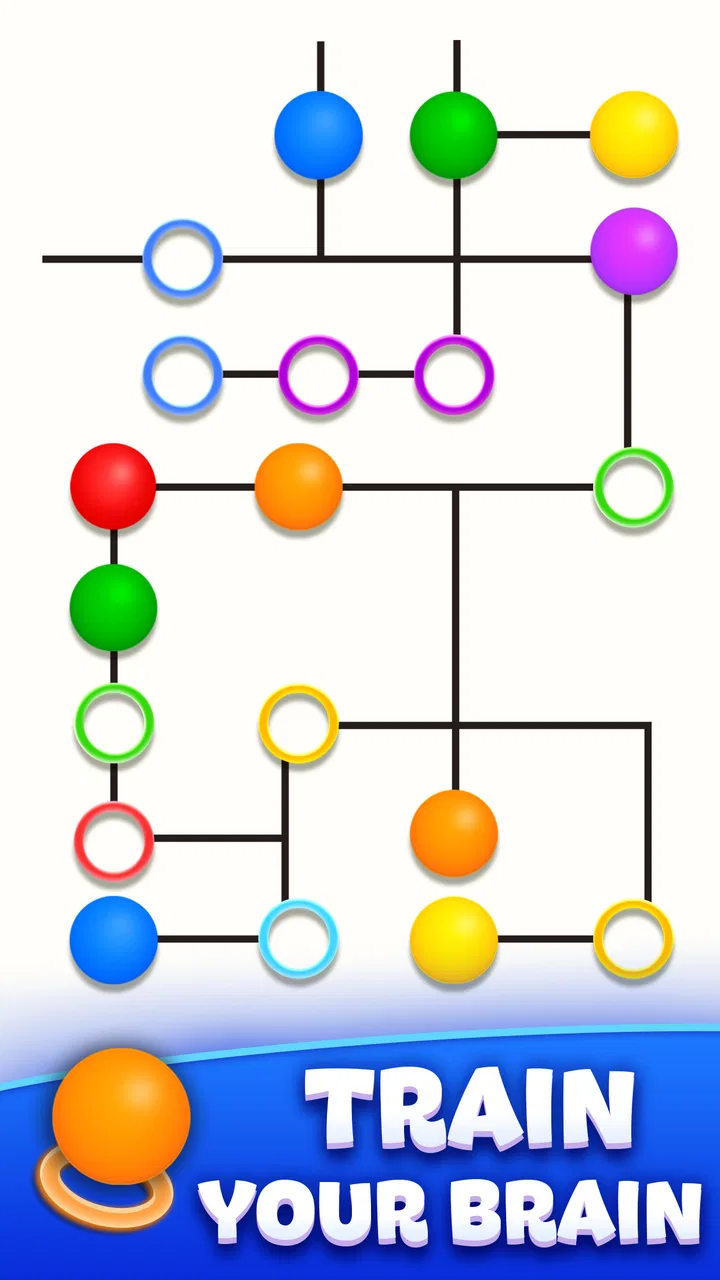
3 Dots - Connect em all
- 4.5
- Rating
- 1.00M
- Installs
- Free
- Price

 Analysis by App-foxy
I downloaded 3 Dots - Connect em all expecting a simple way to fill a few spare minutes, and that is exactly where it makes its best first impression. It is a free board game from LIHUHU PTE. LTD. built around linking matching-colored dots on a grid. The rule is easy to understand almost immediately, but the board still asks you to look ahead before committing to a path. That combination makes the opening sessions pleasantly accessible rather than intimidating.
What interested me more after the first few rounds was not the basic idea itself, but how quickly the game turns a tiny visual task into a question of order. A move that looks correct in isolation can block the only useful route for another color. I found myself restarting a mental plan, checking corners, and trying to preserve open space instead of simply drawing the first connection I noticed. It is a small puzzle loop, but it gives the game enough decision-making to feel more substantial than a purely reflex-based time filler.
From an easy first session to a lasting habit
I use the first stretch with a new puzzle game to decide whether its simple hook has enough room to stay interesting. Here, I’d pay attention not just to how quickly I learn to connect the dots, but to whether I start planning around the board instead of making obvious moves. That shift is a useful test of fit, and it leads naturally to what regular play may feel like over time.
You May Also Like

 Blood Strike: 2.5 Anniversary
Blood Strike’s Loadouts Turn Every Drop Into a Tactical Gamble
A close look at Blood Strike’s custom loadouts: how fast access to signature weapons reshapes its battle royale rhythm, rewards preparation, and narrows the gap between fights.

 Pandora - Music & Podcasts
Pandora’s Music Is Easy to Start, but Harder to Recover
Pandora’s strength is its low-effort path from a seed to a station. Its weak spot is how much confidence it asks you to place in connection, setup, and quiet recovery.

 8 Ball Pool
 Is Built on Rivalries, Rematches, and Routine
A close look at the rivalries, rematches, shared routines, and unanswered safety questions that turn a quick pool match into a persistent mobile community.

 Samsung Music
’s Quiet Strength Is Playing What You Already Own
Its reach comes less from spectacle than from dependable access to a personal library. That simplicity is both the app’s strongest retention engine and its ceiling.

 AccuWeather: Weather Radar
AccuWeather Review: A Quick, Clear Forecast for Everyday Decisions
For everyday plans, the best forecast is the one you can understand quickly. AccuWeather makes rain timing, radar, and local conditions easy to act on, with a few trade-offs.

 Hill Climb Racing
Why Hill Climb Racing Still Turns Crashes Into One More Run
A tiny car, a bumpy hill and one more upgrade: Hill Climb Racing keeps resurfacing because its simple chaos makes every near-miss feel personal.
More From Our News Desk



Why the first week feels so approachable
The strongest part of the first week is the low learning curve. You do not need to study a long tutorial or understand a complicated scoring system before playing. The central action is visible on the board, and the color matching gives every move an immediate purpose. That makes it suitable for a short break, a quiet commute, or the few minutes before going to sleep when I want something interactive but not demanding.
I also like that the game does not require the kind of constant attention found in fast arcade titles. I can pause mentally, inspect the available routes, and continue when I have a better idea. That slower rhythm is useful for players who enjoy board puzzles but do not want a competitive online match. It also makes the game easier to recommend to someone who wants a gentle introduction to mobile puzzle games.
The simple presentation works in its favor during these early sessions. Matching colors gives the board an immediate visual structure, while the limited space creates the real challenge. I do not need elaborate characters or a story to understand what I am trying to achieve. The appeal comes from taking a crowded arrangement and gradually making it orderly.
A practical tip I learned quickly is to avoid connecting the most obvious pair first. I now inspect the whole board, identify colors with only one plausible route, and protect those spaces before dealing with the easier connections. This is a small change in approach, but it reduces the number of self-inflicted dead ends. It also makes the puzzle feel more thoughtful without adding any extra rules.
Another useful habit is to treat the edges differently from the center. A route along the border can be safe because it leaves fewer directions to interfere with, while a connection through the middle may divide the remaining workspace. I do not follow that idea blindly, but it gives me a reliable starting point when the board looks busy. This is the kind of strategy that is not obvious from the short store summary and becomes valuable after several sessions.
Who gets the most from the basic loop
This is a good fit for people who enjoy visual organization, compact logic puzzles, and games that can be played without a long commitment. If you like sorting, matching, or planning a route through a confined space, the central mechanic should feel natural. It is also a reasonable choice for families because the content rating is Everyone and the objective is easy to explain without relying on complicated language.
It suits casual players particularly well because a session can begin and end around your schedule. I can play while waiting for an appointment without worrying about losing the thread of a story or letting a team down. For someone who wants a small daily puzzle rather than a major entertainment hobby, that flexibility is a genuine strength.
On the other hand, I would not choose it for a player who needs constant novelty, a deep narrative, online competition, or a large collection of unrelated modes. The game is focused on its dot-linking idea. That focus helps it stay clear, but it also means the experience depends heavily on whether you enjoy repeating the same kind of spatial problem.
What changes after the novelty fades
The first-week question is whether connecting colored dots feels satisfying enough to repeat. For me, the answer was yes, but with an important qualification: I return for the planning rather than for surprise. Once the basic gesture becomes familiar, the pleasure comes from spotting a route that keeps the whole board workable. That is a quieter reward than discovering a new character or unlocking a dramatic event, so it will not appeal equally to everyone.
In an everyday situation, I would use it as a deliberate reset between tasks. After finishing a block of work, I might play a few boards instead of opening a social feed. The game gives my attention one contained problem, and the visual completion provides a clear stopping point. That works better for me than endless-scroll entertainment when I want a break that feels finished rather than merely interrupted.
There is also a useful distinction between playing for completion and playing for improvement. If I only care about finishing, I can make safer connections and accept a slower solution. If I want to sharpen my thinking, I replay the board mentally before touching the screen and try to reduce unnecessary crossings or awkward detours. The second approach gives the same simple game a little more longevity.
Month-to-month value, maintenance, and fatigue
For me, lasting value is less about keeping up with a schedule and more about whether a game still suits the moments when I reach for it. I’d weigh the low-pressure nature of a short puzzle session against the chance that repeating one central idea eventually feels stale. That balance also makes it worth considering what ongoing value and fatigue look like month to month.
Does it earn regular space on a phone?
After the initial curiosity, the game’s recurring value depends on whether you enjoy a dependable puzzle routine. I can see myself opening it several times a week because the entry cost is low and the rules remain familiar. It works especially well as a small mental warm-up: enough structure to engage me, but not so much complexity that I need to prepare for it.
The public response suggests that many players find that loop worthwhile. It holds an average rating of 4.5 from around 33 thousand ratings, and it has passed over a million installs. Those figures do not guarantee that every player will enjoy the repetition, but they fit my impression that the core mechanic is broadly accessible rather than aimed only at dedicated puzzle enthusiasts.
The current release is version 2.6.3.1, and the game runs on Android 7.0 or later. That makes it relevant to people using older compatible phones as well as newer devices. I would still check the store page on the particular device before installing, especially if the phone is managed by a family member or has limited storage, but the stated operating-system requirement is not unusually demanding.
Because the game is free to start, it is easy to test honestly. I would recommend playing enough boards to see whether the repeated connection process remains enjoyable before considering any optional spending. The in-app purchase range runs from $0.99 to $99.99 per item, so the sensible approach is to treat purchases as a personal choice rather than part of the basic reason to install it. Anyone sharing a device with children should also keep purchase controls in mind.
How much maintenance does the habit require?
The maintenance burden is low in one sense: there is no elaborate collection to organize, no character build to preserve, and no complicated schedule I need to follow. I can leave the game alone for a while and return without feeling behind. That is an advantage over many mobile games that turn regular play into a chore through daily obligations or layered progression.
There is, however, a different kind of maintenance: I have to manage my own expectations. If I approach every board expecting a new mechanic, I will probably become bored. The game asks me to find interest in variations of the same spatial task. I keep it installed when I treat it as a compact thinking exercise, not as my main source of entertainment.
My preferred routine is to stop after a natural sense of completion instead of continuing automatically. A few focused boards feel refreshing; a long, unplanned session can make the colors and paths blur together. This is an important trade-off. The game is strongest when used in small portions, and its convenience can become a weakness if I keep playing after the puzzle has stopped feeling engaging.
For that reason, I would place it alongside a short reading session, a walk, or a simple offline break rather than beside a large action game. It fills a narrow but useful role. It is not trying to replace every kind of mobile entertainment, and I do not think it should be judged by that standard.
Where fatigue begins
The main source of fatigue is repetition. The color-linking idea is clear and satisfying, but its boundaries are also clear. Players who need frequent changes in objectives may feel that the game has shown most of its personality early. Even when the arrangement of dots changes, the mental vocabulary remains similar: inspect, plan, connect, discover a blockage, and adjust.
Another possible frustration is the difference between a challenging mistake and a careless mistake. When I misread the board, the result can feel fair because I can usually identify the route I overlooked. When I move too quickly and close off a needed space, the annoyance is self-created, but it still interrupts the flow. Slowing down helps, although players looking for immediate, effortless relaxation may not appreciate that demand for attention.
The game can also feel less rewarding for people who prefer visible long-term progression. A board puzzle can give me a satisfying local victory without creating a strong sense of personal development. If your motivation comes from unlocking equipment, building a collection, or competing with friends, a different board game will probably provide a stronger reason to return each month.
There is a subtle trade-off between accessibility and depth here. The rules are approachable because they stay focused, but that same focus limits the number of ways the experience can surprise an experienced player. I consider this a fair design choice, not a flaw in itself. It simply means the right audience is someone who values clean repetition over constant expansion.
How it compares with familiar alternatives
Compared with match-three games, this feels more deliberate because the important question is not which pieces disappear immediately, but how one route affects every other route. Match-three titles often reward quick pattern recognition and chain reactions; this game rewards restraint and spatial planning. I prefer this one when I want to think quietly, while I would choose a match-three alternative when I want faster feedback and more visual excitement.
Compared with classic Sudoku, the experience is more visual and less number-focused. I can understand the goal at a glance, and the colored paths make progress feel tangible. Sudoku offers a deeper deduction structure for players who enjoy formal logic, whereas this game is easier to pick up when I am tired or have only a short time available.
Compared with elaborate board-game adaptations, it is much lighter. There are no rules-heavy turns or lengthy setup decisions to learn before starting. That makes it friendlier for casual use, but it also means it cannot offer the strategic variety of a full digital tabletop game. I see it as a pocket puzzle, not a substitute for a complete board-game night.
Those comparisons clarify the lasting-value question. This game earns space when I want a calm, repeatable task with a clear visual goal. It does not earn that space if I am searching for narrative, social competition, deep systems, or a constantly changing set of challenges.
Small strategies that improve the experience
I recommend beginning each board with a scan rather than a swipe. Look for the color pair that has the fewest possible routes, then consider whether its path would divide the board. This prevents the common mistake of spending the easiest connection first and leaving a difficult pair trapped behind it.
When a solution seems impossible, I do not immediately assume the board is unfair. I retrace the last few connections and ask which one consumed a corridor needed by another color. Often the problem is not the final pair but an earlier decision that looked harmless. This review process turns failure into a quick lesson and makes repeated attempts less frustrating.
I also use the game differently depending on my energy. When I am alert, I try to plan several moves ahead. When I am tired, I use it as a gentle visual reset and accept that I may need to reconsider a route. That flexibility is one of its practical strengths: the same simple board can support focused problem-solving or a lighter break, as long as I do not expect it to provide a completely different genre of entertainment.
My long-term verdict
After the novelty fades, 3 Dots - Connect em all remains worthwhile for a specific kind of player. I would keep it installed for anyone who likes compact visual puzzles, prefers calm concentration to fast action, and appreciates a game that can be opened without preparation. Its free entry point makes trying that routine easy, while the Everyone rating makes it a comfortable recommendation for a broad audience.
I would skip it if you quickly tire of repeating one central mechanic, need a story or social layer to maintain interest, or want a game with a clearly expanding strategic system. The optional purchases, ranging from $0.99 to $99.99 per item, are another reason to decide your spending boundaries before using it regularly. The core appeal should be strong enough on its own; buying something will not change whether you enjoy connecting the dots.
My final assessment is positive but measured. This is not a game I would play for hours every day, and I do not think it needs to be. Its lasting value comes from being easy to revisit, mentally engaging in short bursts, and free of the maintenance demands that make many mobile games feel like obligations. Its best role is a small, repeatable thinking break, and in that role it does its job well.
If that sounds like the kind of habit you want, I think it deserves a trial. Give the boards enough time to move beyond the first easy wins, use the edge-and-corridor approach when routes become crowded, and notice whether the act of planning still feels satisfying after the first week. If it does, this board game can quietly remain useful for months. If it does not, you will probably know early, and there is little reason to force a puzzle whose simple loop is not matching the way you like to play.
FAQs for 3 Dots - Connect em all
01What is the main objective of 3 Dots - Connect em all?
The primary goal of 3 Dots - Connect em all is to connect dots of the same color on a grid to complete various levels. As players progress, the levels become more challenging, requiring strategic thinking and planning to solve increasingly complex puzzles. The game is designed to test your problem-solving skills while providing engaging and entertaining gameplay.
02Is 3 Dots - Connect em all suitable for all age groups?
Yes, 3 Dots - Connect em all is suitable for players of all ages. The game’s simple mechanics make it accessible to younger players, while the increasing difficulty in higher levels keeps it challenging for adults. It’s an ideal choice for family-friendly entertainment that encourages critical thinking and concentration.
03Does 3 Dots - Connect em all require an internet connection to play?
No, 3 Dots - Connect em all can be played offline. This feature makes it convenient for users who want to enjoy the game without worrying about internet connectivity. Players can engage with the puzzles anytime and anywhere, whether they are on a commute or in an area with limited internet access.
04What are the in-app purchase options available in 3 Dots - Connect em all?
3 Dots - Connect em all offers a variety of in-app purchases to enhance the gaming experience. Players can purchase hints or remove ads to enjoy uninterrupted gameplay. These purchases are optional, and players can still fully enjoy the game without spending money, as all levels are accessible through skillful play.
05How does 3 Dots - Connect em all handle user data and privacy?
3 Dots - Connect em all prioritizes user privacy and data protection. The app collects minimal data, primarily for enhancing user experience and providing personalized content. Users have control over their data, with options to manage permissions and privacy settings within the app. The app adheres to industry standards for data security.
Pros
- Intuitive and easy-to-use interface.
- Engaging puzzles that increase in difficulty.
- Bright and appealing graphics.
- Smooth performance with no lag.
- Offline mode available for on-the-go play.
Cons
- Lacks multiplayer or social features.
- In-app purchases can be pricey.
- Ads can be intrusive at times.
- Limited hints without purchasing.
- No daily rewards or incentives.

3 Dots - Connect em all
Gallery